
Posts By :

Vitek AS

Has your sink started to gurgle? If so, your pipes need flushing.

Has your sink started to gurgle? If so, your pipes need flushing. 2560 800 Vitek AS

– Has your sink started to gurgle? If so, your pipes are starting to become blocked and need flushing.

Many people do not realise that drainpipes become blocked as the years go by. Very few people realise that this can be prevented by flushing the pipes.

– Out of sight, out of mind. Pipes need maintenance just like the façade of a house, says Kjetil Pederse, operations manager at Vitek

I think the drain is a rubbish bin

For 15 years, Pedersen has been unblocking pipes in Western Norway, and he has seen just about everything.

– Some people think the drain is a rubbish bin. We’ve fished everything from mobile phones to an entire Christmas tree out of drains. We found the Christmas tree in a 600 mm public sewer pipe. In one home, we fished out a whole fish that someone had flushed down the toilet because it had started to smell in the fridge. That turned out to be an expensive fish.
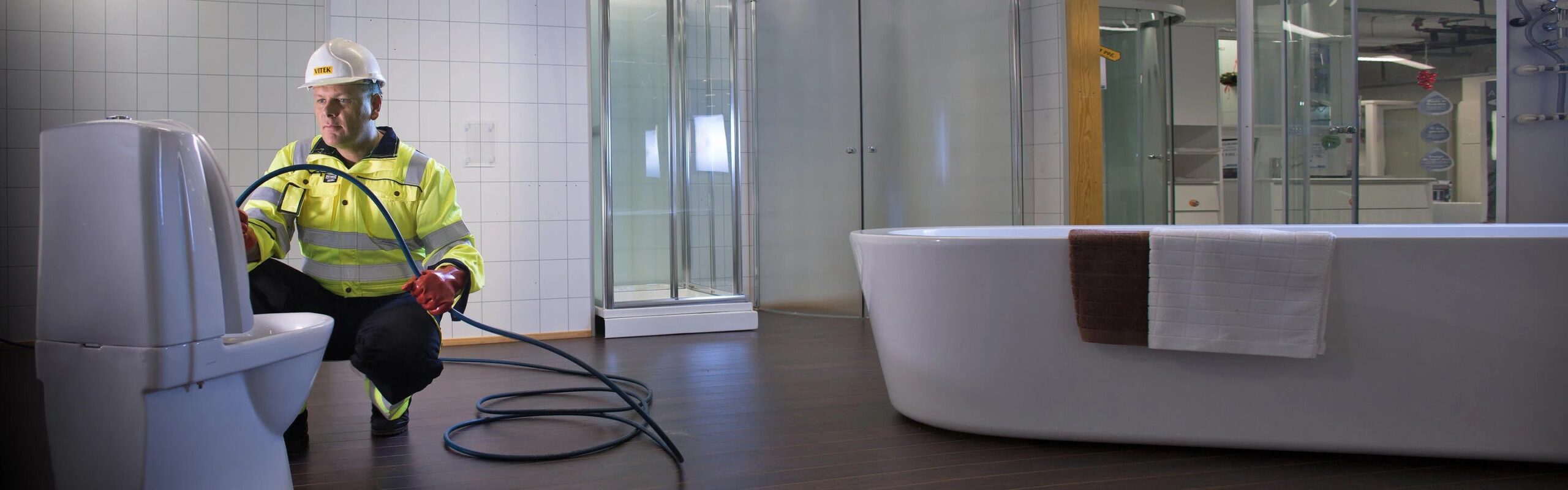
Vitek – flushing

Fat clogs up pipes

Removing grease from the sewer system costs Norwegian residents millions of kroner. Yet every year, the amount of grease flushed down the drain increases. This is thought to be due to increased consumption of cooking fats and oils.

– In the past, people used to save their cooking fat and reuse it. Nowadays, people pour it down the kitchen sink, and the fat forms large blockages in the drainpipes. This is something we notice particularly at Christmas time, as we often have to go out on jobs like this then.

Major sewer damage

In the worst-case scenario, blocked pipes in private households can cause damage running into millions of kroner.

– Last year, we were out on a job at a detached house where the main drain had become blocked. The sewage had risen as high as the third step on the basement staircase. The restoration company that had been awarded the contract was hoping they could save the basement ceiling. Needless to say, it was impossible to live in the house.

Gurgling and noises

Pedersen urges people to check their basements. The first sign that the pipes are starting to become blocked is noise.

– When the sinks start to gurgle, it’s time to have the pipes flushed out. All you need to do is contact Vitek. We take on all jobs, from small bathroom washbasins to the largest municipal pipes.

In private homes and flats, Vitek flushes the pipes in kitchens and the drains in bathrooms and other wet rooms. The pipes are flushed with hot water using a rotating nozzle, right through to the main drain.

– During such a flush, we will also detect any faults or leaks in the pipes.

In such cases, Vitek will first carry out a pipe inspection, just to be on the safe side.

– It may be necessary to replace the pipes. Trenchless methods are an option here, as they mean there is no need to break through walls or chipp away at floors to replace the pipes, says Pedersen.

NATO exercise meant a lot of work for Vitek

NATO exercise meant a lot of work for Vitek 640 480 Vitek AS

Vitek Miljø has removed almost 100 containers following Trident Juncture.

«In addition, we have removed around 1,500 cubic metres of septic tank waste and some sludge, and carried out cleaning work on 14 tankers in Åndalsnes. »It’s been four hectic and enjoyable weeks,” says Asle Skålevik, head of the Hazardous Waste Department at Vitek.

The Trident Juncture 18 military exercise recently came to an end. In October and November, around 50,000 participants, 250 aircraft, 65 ships and 10,000 land vehicles from 31 nations gathered in Trøndelag, Møre og Romsdal, Østfold, Oppland and Hedmark, as well as in airspace and maritime areas in Sweden and Finland. This has been the second-largest NATO exercise since the end of the Cold War.


From Bergen to Trondheim

And Vitek Miljø has contributed its expertise.

«Our work has mainly taken place in Trondheim, but also in Bergen, Kristiansund, Molde, Oslo, Stavanger and Åndalsnes,» says Asle Skålevik. He reports that the feedback on the work carried out has been very positive.

Some of the work has been carried out by subcontractors.

These are partners who have been quality-assured by us and with whom we have worked closely for a long time.

MAJOR EXERCISE: The Trident Juncture 18 military exercise recently came to an end. This has been the second-largest NATO exercise since the end of the Cold War.


Do you know where your service pipe is?

Do you know where your service pipe is? 2560 2560 Vitek AS

A quarter of Norwegian homeowners do not know whether they have a service pipe. This could end up costing them dearly.

Local authorities provide water and sewerage services to residents via their main pipelines. In total, there are 100,000 km of municipal water and sewerage mains in Norway. The country’s homeowners, for their part, are responsible for a staggering 180,000 kilometres of service pipes. That’s a lot.

Service pipes are buried on the property owners’ own land. They may also be located on neighbours’ land – beneath and alongside roads. The pipes can range in length from 1 metre to many kilometres and are owned by the property owner alone or jointly with neighbours.

Living in ignorance

A survey by Norsk Vann shows that 26 per cent of residents do not know whether they own the water and sewerage service pipes. 34 per cent do not know whether they own a service pipe jointly with their neighbour. Only 40 per cent know where the service pipes are located on their property, and 34 per cent know what condition the pipes are in. It is therefore quite possible that you yourself are the owner of a service pipe without having the slightest idea about it.

Surveys show that homeowners in Oslo know the least about their service pipes, whilst homeowners in Northern Norway know the most. Female homeowners generally score lower than men.

Maintenance requirements

Like most other things, service pipes need to be maintained and replaced. However, few homeowners currently ensure that this maintenance is carried out. It is claimed – although this is not easy to substantiate – that service pipes account for around half of the leaks in the water supply network. If the deterioration goes on for too long, the bill can be sky-high. Buying and installing a new water and drainage system can easily cost you between 200,000 and 300,000 kroner.

Map out your facility!

It is therefore important to clarify the status of your facility.
Vitek advises all housing cooperatives and homeowners to find out where the service pipes are located. This is also important to ensure that the pipes are not damaged by building work or other activities on the property. Once you know where your pipes are, it is a good idea to check what condition they are in.

For many years, Vitek has been carrying out pipe inspections. We do this by inserting a camera into the pipes, which gives us a clear overview of their condition. And if your pipes need maintenance, pipe rehabilitation may be a good option.

In our experience, pipe relining is a quicker and cheaper method than replacing the old pipes with new ones. In short, the method involves installing new pipes inside the old ones. This means we do not need to dig up gardens, break up floors or knock down walls. This is a great benefit for everyone.

Vitek has upgraded more than 10,000 metres of pipework using LED technology

Vitek has upgraded more than 10,000 metres of pipework using LED technology 2560 2560 Vitek AS

In many European countries, light curing is a well-established method in the field of pipe rehabilitation. In Norway, Vitek has for several years been virtually the only company able to offer this method to the market.

– In this field, Vitek in Norway can almost be considered veterans. We have been working on this for many years. As early as autumn 2014, we carried out our first LED installation in Norway in collaboration with the Danish company Aarsleff, says Bengt Rebnord Olsen of Vitek.

Cures with UV light

In pipe rehabilitation, new pipes are installed inside the old ones without the need for excavation. The old pipes are rehabilitated using a liner. The liner is then cured. In Norway, it has been common practice to cure the liner using steam, but light technology is a very good alternative for smaller pipes of smaller diameters (100–225 mm). It can be used for all types of sewer pipes, including branch pipes.

– In short, LED curing is a form of UV curing. The LED light is similar to the light that dentists use to cure fillings. The difference is that the lining we use in the pipes is fibreglass-based, explains Olsen.

Out early

In many European countries, light curing is a well-established method in the field of pipe rehabilitation. In Norway, Vitek has for several years been virtually the only company able to offer this method to the market. In 2015, the company purchased its own vehicle for fibreglass and LED curing.

– The method is used outdoors on underground cables. We do not currently carry out curing using light indoors. We have, however, carried out several hundred installations using UV light. We continue to collaborate with Aarsleff, but we are a supplier-independent company.

– Steam is the most common

Olsen emphasises that, whilst the use of felt lining and steam curing remains the most common method in pipe rehabilitation, the market is changing.

– The difference is that the lining is fibreglass-based. The standard method has been – and remains the most common – felt lining and steam curing. However, several Norwegian companies have now realised that UV technology exists. This is changing the market and demand, says Olsen, who explains that Vitek is carrying out further tests to expand the range of applications for UV light.

– There’s a lot going on in the market at the moment. There are plenty of new solutions on the horizon.

That’s why you should check the pipes in your home!

That’s why you should check the pipes in your home! 2120 1415 Vitek AS

All homeowners know that the gutters need to be cleared of leaves in winter and that the house needs to be painted from time to time. Unfortunately, very few people realise that the pipes in their house or flat also need to be maintained.

Many people only realise this when the pipes become blocked or the floor is flooded. Then everyone knows that this is going to be EXPENSIVE!

This is a cost that homeowners can avoid by having regular pipe inspections carried out. A pipe inspection provides a good overview of the condition of the pipework, as well as details of where the pipes are buried. You will also receive any recommendations for necessary repairs.

It could save you from unpleasant and costly expenses in the future, as every year, old and faulty pipes lead to costly water damage in Norwegian homes.

What are some signs that you need a pipe inspection? If you find that your pipes often become blocked, that it takes a long time for the water to drain away in the sink or shower, or that there is a foul smell coming from the pipes? If so, it might be a good idea to have the pipes in your home inspected.

Vitek has extensive experience in carrying out pipe inspections.

Here’s how we do it:

We film the inside of the pipes using a specialised camera that is fed into the pipes via existing manhole covers, septic tanks, inspection chambers or external chambers.

We use advanced equipment suitable for all types of main pipes, service pipes and ventilation ducts, both offshore and onshore. The measurement results are stored electronically and followed up with detailed written reports, based on the Norwegian Water Standard.

Common errors we come across are:

  • sags when filled with water
  • reversal
  • fracture injuries
  • irregularities in pipe walls
  • deposits
  • foreign objects in the drain

If these faults are rectified in good time, you can save a lot of money and you can relax and sleep more soundly when it’s pouring with rain.

Are you worried about the condition of your pipes, get in touch with Vitek! We’re always up for a chat about pipes!

Do you have an oil tank that needs to be removed?

Do you have an oil tank that needs to be removed? 2560 1707 Vitek AS

DO YOU HAVE AN UNDERGROUND OIL TANK IN YOUR GARDEN?

From 2020, the use of fossil fuel oil for heating buildings will be banned. Across the country there are thousands of underground oil tanks, which can be harmful to both the environment and human health. These must be removed.

It’s a good idea to do this during 2018, as you can then apply for funding from Enova. The amount of support will be halved in 2019 and will cease in 2020.

We would like to emphasise that As a homeowner, you are liable for any oil spill. It can be very expensive. I would advise anyone with an underground tank to contact Vitek. At the moment, we are removing one or two oil tanks a week. We have many years’ experience and expertise in tank cleaning and removal, says the department manager.

Here is our recommendation: Emptying, cleaning, decontaminating or removing an underground oil tank should be carried out by professionals who are certified for the job.

How to proceed

An oil tank should be emptied, decontaminated or removed by a certified company. As a homeowner, you should have the following information about the tank:

  • Age
  • What is the tank made of (steel, fibreglass, etc.)?
  • Last condition check
  • Size
  • Routing of cables to the tank
  • Current contents of the tank
  • Where in the garden is the tank situated?

If you need further information, please contact your local council and ask if they can help you.

Read more about our hazardous waste services here.

Removing the tank

You can choose whether the tank should simply be emptied, cleaned, decontaminated or removed entirely. We recommend that it be removed.

All associated pipes on the wall must also be emptied and removed. The same applies to the day tank inside your house. If you have an indoor cellar tank, this should also be emptied, decontaminated, dismantled and removed.

Reporting

Once the tank has been decontaminated and delivered to an approved collection point, this must be reported to the local authority. All companies carrying out tank decontamination are required to do this, but it is you, as the property owner, who bears ultimate responsibility for ensuring that it is done.

New and environmentally friendly heating

An oil-fired boiler is usually connected to a central heating system with radiators or underfloor heating. It can be replaced with heating solutions that can be connected to the water-based heat distribution system.

Good alternatives might include solutions based on wood combustion or various heat pump systems, such as air-to-water heat pumps, liquid-to-water heat pumps, pellet boilers, pellet burners or wood-fired boilers.

Other heating solutions include solar heating or district heating.

Read more about Enova’s support schemes here

Please contact Vitek if you have an underground oil tank and need assistance.